
Black and White ~ 黑白分明
Shades of gray whenever I go.
The more I find out the less that I know.
Black and white is how it should be
But shades of gray are the colours I see.
The more I find out the less that I know.
Black and white is how it should be
But shades of gray are the colours I see.
~ Billy Joel

Few years ago, an enthusiastic newbie in the Goldfish hobby asked me about the finer points of Goldfish appreciation. He was trying to compile a holy grail guideline on how to select a good specimen of any variety of Goldfish. I tried to explain to him that although there is a general guideline of what constituents a good specimen of Goldfish, delving into the finer points involves the "feel factor" and years of constant exposure to Goldfish. These experiences and feelings could not be expressed easily with words. Unfortunately (or fortunately), he gave up his quest for the "mother-of-all-Goldfish-selection-guideline", thinking that I did not want to share my views. Today, I learned my lesson well and would readily reiterate this evergreen slogan to most novices eager for a quick answer: "if you like the fish, than it is a good fish". In the context of most people acquiring a Goldfish for personal appreciation, why need bother about what others think if you truly like the fish? :)

Life is not really so straight forward that we can always quantify anything as absolute good or bad. No doubt there are basic rules governing any form of standards, Art is a realm void of this clear boundary especially when it comes to the finer details. Ironically, it is the kaleidoscope of shades of gray between black and white that make our lives so much more colourful and interesting, albeit frustrating at times.
Unlike most other ornamental fishes where similar varieties exhibit highly uniform traits and thus show standards could rigidly spell out the expectations of a good specimen, it is not as easy when it comes to Goldfish. The Goldfish's colouration, body structure, tail length, body proportion with respect to its finnages varies across different varieties and even within close siblings. Moreover, the ever evolving new varieties and hybrids with varied compositions of fanciful features further complicate things.

In my humble opinion of a good fish, the basic traits showing the breed's specific characteristics must first be satisfied. For example, an Oranda should have wen growth and a Ryukin should have back hump. The other major factor is how its features harmonise as a whole. Let's take the analogy of ladies and their hairdos - not all ladies are suited for long hairdos - their hairdos should match with the shape of the face, dressing, body height, etc. It would be myopic to stereotype that any lady would look her best with a long hairdo just as it would to conclude that any Ranchu with a beautiful head of wen is a good show grade fish.
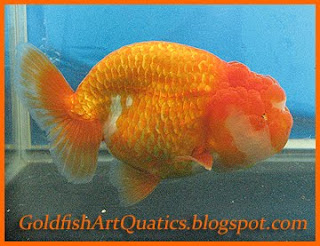
The field of aesthetics is also very subjective and full of exceptions - contrast and complements could highlight or compensate certain visual perspectives. With the right combination, it could enhance the subject's innate beauty and charisma. For example, the longish body (shunned by most modern Goldfish hobbyists) of some classical Goldfish varieties is complemented by long wavy droopy tails emanating a fairy-like grace. However, even if we have a comprehensive set of judging criteria and experience judges, there will still be some minor areas biased by personal aesthetic values and preferences. A good show would mitigate this by having more judges to steer the outcome towards majority views.

We are very fortunate to live in the Internet era where Science and Technology are so advance that information travels across the world within seconds. However, the field of Science has zero tolerance for ambiguity and some of us have become accustomed to quantify everything rigidly in just black or white.
Goldfish appreciation is more of an Art than a Science; the fancy breeds man creates for ornamental pleasure should have more avenue for imagination and creativity. As we embrace Science and Technology, lets also take some respite in Art and ponder over how we can appreciate life's many imperfections :)


Unlike most other ornamental fishes where similar varieties exhibit highly uniform traits and thus show standards could rigidly spell out the expectations of a good specimen, it is not as easy when it comes to Goldfish. The Goldfish's colouration, body structure, tail length, body proportion with respect to its finnages varies across different varieties and even within close siblings. Moreover, the ever evolving new varieties and hybrids with varied compositions of fanciful features further complicate things.


Ranking chart in AJRS showing that opinions of experience judges are not necessary always unanimous. Horizontal rows are the names of the Ranchu owners, vertical rows are the judges' names and their respective ranking 1 (best) to 6 of the fishes. The smaller the total score, the higher the ranking of the fish. If there is a tie, the Chief Judge will decide the ranking.
We are very fortunate to live in the Internet era where Science and Technology are so advance that information travels across the world within seconds. However, the field of Science has zero tolerance for ambiguity and some of us have become accustomed to quantify everything rigidly in just black or white.
Goldfish appreciation is more of an Art than a Science; the fancy breeds man creates for ornamental pleasure should have more avenue for imagination and creativity. As we embrace Science and Technology, lets also take some respite in Art and ponder over how we can appreciate life's many imperfections :)
Pictures:
1) My stable lines of black and white Dragon Eyes Pearlscales.
2) A very high grade Calico Dragon Eyes Butterfly showing good balance features and a unique colouration. The top view Dragon Eye Butterfly in the same picture is also a fantastic specimen.
3) Dragon Eyes, Butterfly or Pearlscale? How to appreciate this new variety?
4) A nice Ranchu excellent for personal appreciation but not likely any chance in shows due to a tail flaw.
5) A score chart showing even the very experience judges in Japan's All Japan Ranchu Show (AJRS) are not unanimous in their ranking of Ranchu in the final round. Final Ranking is based on the majority vote.





 Posts


